Peter Davey, retired housing and charity consultant, paid tribute to Hattie Llewelyn-Davies, who sadly passed away on the 23rd May 2026. This is the address he delivered to her funeral on 15th June.
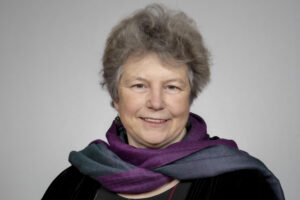
Hattie-Llewelyn-Davies. Photo: Watford Community Housing
Hattie was a truly remarkable person. She possessed a rare combination of qualities: humanity, kindness, clarity, determination, and was completely devoted to improving the lives and life chances of homeless people, tenants and residents, and others lacking a voice.
Hattie’s housing career spanned more than half a century – and she led, developed, advised and participated in hundreds of organisations along the way. Please forgive me if your organisation isn’t mentioned – as her friend and colleague since we first worked together in 1980, I can say with complete confidence, ‘Hattie hadn’t forgotten you.’
Early work with homelessness and young people
It was clear from the start that Hattie would never be someone content to follow in other people’s footsteps. When she left school in 1972, rather than heading to university as expected, she set off to West London Mission to work with homeless people. Within a year, she was serving on several management committees, before taking her first chairing role at Single Homeless Project – established by six homeless men wanting better alternatives to rough sleeping.
By her early-20s, as founder and Director of the Piccadilly Advice Centre, she was pioneering an innovative approach to youth homelessness in London’s West End. An approach that was founded on her belief that, given the right advice, young people were resourceful and capable of finding their own solutions to the many challenges they faced.
Hattie’s energy, drive and passion could make things happen quickly. And this is when she first showed her understanding of the powerful connection between health and housing. She was, for example, instrumental in developing Great Chapel Street walk in medical centre for homeless people. And in building the Aids and Housing Project and Strutton Housing Association that convinced policy makers that people living with HIV could live independently in adapted housing rather than requiring residential care.
Many of the principles that underpinned Hattie’s career began to emerge in these early days – her respect for people and their lived experience; her humanity; her drive to build better services. For anyone who wants to know more, I recommend her contribution to the first episode of the BBC’s 2022 documentary, The Nilsen Files, which – for me – distils the essence of the very special woman we were so privileged to know.
Leadership, governance and problem-solving
With all this experience behind her and now entering her 30s, Hattie moved into senior leadership roles within mainstream housing associations, first as area director at Circle 33 Housing Trust; then as chief executive of Shepherds Bush Housing Group. She was also elected to the council of the National Housing Federation and was a trustee of the Housing Associations Charitable Trust.
This decade of hands-on housing delivery further developed the practical, technical and leadership skills that Hattie deployed so successfully when, in 1996, she moved on to develop a “portfolio career” – a role that made the very best of her talent for lateral thinking, her empathy, and her ability to apply the depth and breadth of her knowledge to new circumstances. With each challenging interim chief executive role she took on, her reputation as a talented and effective problem solver grew. And the breadth of her non-executive roles – in long established housing associations of all sizes like Islington and Shoreditch, Octavia and Peabody, and in stock transfers such as Ridgehill – demonstrated her exceptional governance skills.
In recent times Hattie became a huge champion of ‘community gateway’ associations such as Eastlight Community Homes and Chime, which came into being at the beginning of this month through a merger of Watford Community Housing and Thrive Homes. Hattie was delighted to discover that ‘chime’ – which at first sounded to her a bit too much like “Avon Calling” – is the collective noun for wrens – and a wren silhouette is now their logo.
Values: participation, inclusion and connected services
So, what made Hattie so special, unique even?
Her personal qualities, certainly: She was kind, generous, thoughtful, deeply intelligent, compassionate, determined, highly principled, and a consummate professional, with an unwavering commitment to every dimension of equality. She lived her values.
Her drive to do things better: She never forgot her early commitment to doing what was right not what was easy. And importantly, she would always listen, take heed and find ways of solving problems and bringing people along with her.
She was generous in sharing her experience and wisdom: Hattie was an invaluable sounding board for numerous chief executives – as a consultant, as a Chair and as a mentor, and often (informally) as a friend. She was (usually) calm. Her moments of exasperation were rare, and invariably private. She inspired huge respect, and a lot of love.
She was passionately committed to meaningful participation: Hattie was absolutely clear that people with lived experience must be at the heart of governance and decision making, shaping not just what organisations do, but how they think and act.
She was a powerful advocate for connected services: Hattie consistently pushed for closer working between health and housing and argued strongly for the need to better connect services around people’s lives.
Her impatience with attitudes that stereotype and exclude: Hattie spoke openly about her own experience of disability. Living with an auto-immune condition, she understood the reality of having a non-visible disability. She was always ready to challenge stigma and push for greater inclusion and representation, particularly in leadership roles.
Recognition and lasting legacy
In 2025 Hattie was the first recipient of the Lifetime Achievement in Inclusion and Business Leadership award. It has now been renamed in her honour: from this year it will be The Hattie Llewelyn-Davies Lifetime Impact in Inclusive Leadership Award. Nominations are now open.
When asked about her motivation, Hattie would say: “it’s what you do.” She leaves behind an extraordinary legacy through the work she did, the organisations she helped to shape for the better, and the many lives she touched. The concluding sentence of the citation for her 2004 OBE for services to homeless people feels an appropriate way to end this tribute to an exceptional woman and a dear friend:
Hattie has always maintained a steadfast belief in the innate abilities and talents of every individual, and the importance of working with people in ways which help them to help themselves. She continues to provide a shining example of exemplary public service.
Hattie Llewelyn-Davies obituary | Charities | The Guardian
To reach out, email: James Tickell: James.Tickell@campbelltickell.com