Building our future: increasing the supply of older people’s housing
Abdul A Ravat – written in a personal capacity.
The UK population is not only growing but also ageing: in the next decade, the number of people aged 65 and over will have grown from 11 to 13 million people. There is significant undersupply and critical challenges in increasing the supply of new homes for our ageing and increasingly diverse population. Only around 5,000 to 7,000 later-living homes are completed each year, compared with roughly 200,000 new homes overall – yet 84% of projected household growth to 2043 will be among over-65s. We all want to see the 1.5 million homes target met but this must be achieved in a way that also meets the current needs of older people and responds to an ageing demographic.
Greater life expectancy, in addition to the growing population, is increasing the need for older people’s housing of all kinds. Changes to lifestyle and the expectations of an ageing population will continue to influence the housing model for older people – from adaptations and services that can support people to live at home through to specialist residential care provision.
On paper, it looks as though there is a broad range of housing options in the UK. However, we must ask whether there is equity of provision in all parts of the country and for everyone in society, particularly for those with modest means? It is my view that we must do more to provide for a growing and a more diverse older population.
This is a failure that has slowly crept upon us over many years due to a variety of pressures that have disincentivised the building of new homes for older people. The NHF’s Older Person Housing Group, Housing & Ageing Alliance, BME National, National Care Forum and others have all urged the Government to prioritise older people’s housing in its soon to be published Long-Term National Housing Strategy.
Actions to reform older people’s housing
I genuinely believe we have a golden opportunity for reform which we must harness. But to achieve this four key actions are needed, all of which are within the gift of Government and would be transformative:
- Maintain and extend a specific target for older people’s housing delivery within the Social & Affordable Homes Programme (SAHP) 2026–2031. This is essential to drive the step change needed in specialist housing supply and reflects the Older People’s Housing Taskforce’s recommended a minimum of 10%.
- Mandate M4(2) accessibility standards as a minimum for all general needs homes funded through the SAHP and Section 106 to ensure long-term suitability and regional equity in accessible housing provision. But more broadly, we want Government to change the building regulations so that M4(2) homes become the industry norm.
- Require strategic partners to allocate a greater proportion of grant-funded homes to older people, making this a condition of funding to ensure delivery aligns with national priorities and local pressures.
- Address the inherent funding challenges faced by predominately smaller providers within much of the existing stock for older resident to adapt / remodel / improve / regenerate and adopt a broader definition of additionality. The recommendation in the APPG Inquiry looking at the Regeneration of Outdated Sheltered Housing was quite clear that up to a third of the 10% target within SAHP should be made available. But there has been little reaction from the Ministry for Housing, Communities and Local Government (MHCLG), Homes England or the Greater London Authority (GLA).
There also needs to be closer cross-government commitment to older people’s housing with, for example, the Department for Health & Social Care (DHSC) purposefully recognising and acting on the role housing plays in its priorities and future work.
Not investing in appropriate housing and support for older people is a false economy and we will all pay a heavy price. Forthcoming strategies and the SAHP Prospectus provide an opportunity for action. A long-term housing strategy that does not fully recognise and address the needs of an ageing population will simply be a short-term sticking plaster.
We know that 2024 was an important year for realising that change was needed and essential as we transitioned the economy and our housing market, and confronted the challenges of an ageing and increasingly diverse population.
- At the end of 2024, the Older People’s Housing Taskforce appointed jointly by MHCLG and the DHSC published its independent report setting out 10 key recommendations for transforming housing for our ageing population. There was an understanding that we must confront these issues holistically from the perspective of housing, care and health.
- In July 2024, the APPG for Housing & Care of Older People, published its report from the Inquiry looking at the Regeneration of Outdated Sheltered Housing recommending that focus and funding was also needed to help providers retain their existing stock at a time when build rates are not keeping pace with demand and demographics. And whilst the Abbeyfield Movement initiated this Inquiry, the jury is still out as to whether this has been recognised by the Treasury, MHCLG and its Delivery Agencies.
But there is also deep anxiety and disappointment that not enough noise and priority is cutting through with Ministers, MHCLG and its Delivery Agencies that despite providing a robust evidence base to support the Later Living Sector’s asks, as well as reforming of the Older People’s Shared Ownership model, we are still scrapping around for clarity and strategy.
As Lord Richard Best summarised the problem to me recently:
The obstacles are that Government fears housing for older people will be proportionately more expensive, meaning the SAHP will achieve fewer homes. They fail to recognise the savings in other Government Departments, which will more than compensate. And the social housing providers have the extra expense on the revenue side, which local authorities resist supporting despite the savings to their social care budgets. We need Ministers that are bold and can see the bigger picture.
Immediate action
We therefore could not wait any longer and stand by and which prompted my fellow colleagues in the Housing & Ageing Alliance to write to the following:
- Steve Reed OBE MP, Secretary of State for Housing, Communities & Local Government.
- Pat Ritchie, Interim Chair, Amy Rees CB, Chief Executive, Homes England.
- Tom Copley, Deputy Mayor for Housing and Residential Development, GLA.
And bringing matters up to date, there are issues of definition, coverage and impact from recent announcements. For example, the GLA, which requires all new homes in member boroughs to be built to the M4(2) accessible and adaptable standard, is now fast tracking developments with a lower percentage of affordable homes, meaning fewer accessible housing options for less well-off older people. (Though it’s worth noting that even with this policy requirement the London Plan Monitoring Report would suggest a wide variation in what actually gets built across the capital).
Outside the GLA, there are risks of downward pressure on affordable homes by developers on grounds of viability, which can supress delivery of accessible homes where policies require a higher proportion of accessible homes in affordable tenures. This is particularly risky for M4(3) wheelchair accessible homes as they are often specified in Local Plans for affordable tenures only. Furthermore, the recent launch of the Healthy Homes Standard by the Government mentions Part M (2) but its adoption is not made mandatory. And the New Towns Taskforce report makes only vague and problematic reference to accessible homes, saying it’s important for new towns to ‘…include homes for older people, as well as specialist housing built to accessible and adaptable standards’.
As Christina McGill, Director of Social Impact and External Affairs at Habinteg explained to me:
Even the language used in the Taskforce report is misleading, conflating the concept of ‘accessible and adaptable’ with ‘specialist’ which really doubles down on the huge misunderstanding among the housing industry about the building regulations. We really need Government leaders to understand and start explaining that the M4(2) accessible and adaptable standard is an inclusive standard and not something just for older and disabled people’s settings, although of course this constituency benefits hugely from increasing supply in all tenures.
Without decisive action, we risk compounding pressures on health and social care systems and missing a critical opportunity to create age-friendly, inclusive communities.
Time has virtually run out to influence and shape key Government actions that would lift the challenges that will confront the next generation of older people and that includes me. I therefore humbly request my fellow colleagues and the sector to take two simple steps immediately:
- That in your discussions with Government and its Delivery Agencies ask how older person housing will be positioned across Government action points.
- Join in with the wider sector campaign and awareness to highlight that not investing in appropriate housing and support for older people is a false economy and we all pay a heavy price for the inertia and inaction.
Notes:
- Professionally, Abdul A Ravat is affiliated with the following organisations and groups: Abbeyfield Living Society; Chair of the NHF’s Older Person Housing Group; Member of the Housing & Ageing Alliance; Lead Executive for Ageing Well, BME National; Board Member for InCommunities; Board Director for Funding Affordable Homes Housing Association
- To discuss any issues raised in this blog, please email: Holly.Holder@campbelltickell.com
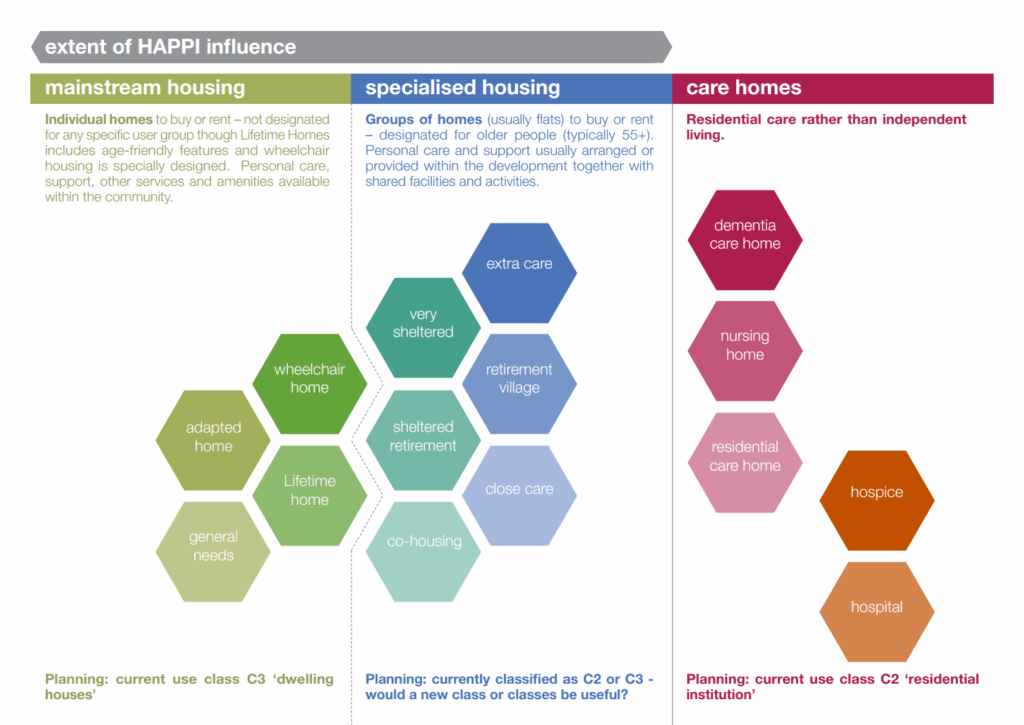
- The diagram below demonstrates the mix of Housing Options for Older People outlined by Housing our Ageing Population Panel for Innovation (HAPPI) available on Housing LIN’s website.
Disclaimer: We welcome guest blogs and articles for our website and CT Brief. The views, opinions and positions expressed in such blogs and articles represent those of the authors and do not necessarily represent those of Campbell Tickell.