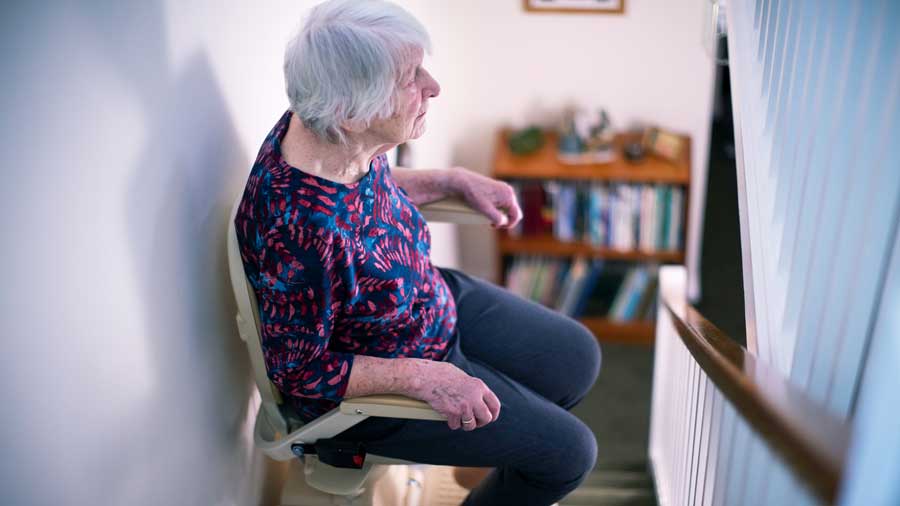
Image: Age Without Limits/Elliot Manches
Retirement housing
Purpose-built later-life communities are the solution to our housing crisis that’s hiding in plain sight

HEALTH, CARE & SUPPORT

Paul Teverson
Director, Retirement Housing Group
Paul Teverson
Director, Retirement Housing Group
Issue 82 | February 2026
The national debate about ageing has revolved around similar themes throughout my career in the sector: rising care pressures, loneliness, the shortage of suitable housing options and spiralling NHS costs.
A solution to these pressures sits in front of us in the form of retirement housing. This type of accommodation, across all types and tenures, offers one of the most effective ways to support healthy, independent ageing. These are not care homes. They are purpose-built communities designed for independent later life, providing safe, accessible homes with flexible onsite support and often care, alongside a readymade social network. And demand spans every tenure: social rent, shared ownership, private rent and private sale.
Not a policy priority
Despite its clear benefits, retirement housing remains marginal in national policy. There are around 780,000 retirement properties in the UK and it is a critical part of the UK’s housing infrastructure. However, new supply has collapsed. In the 1980s, around 20,000 retirement homes were built each year but now it is nearer to 7,000. Estimates suggest there is demand for 50,000 new retirement properties a year, which would be a meaningful contribution to the target of 1.5 million new homes.
There have been a few encouraging signals recently: Homes England has committed to including older people’s housing within its £39 billion affordable homes programme from this year, and December’s revised National Planning Policy Framework included stronger references to ageing. But these are isolated steps, not a coherent strategy, and there remain few policy references to encouraging this form of housing.
total number of retirement properties in the UK
number of new retirement homes it is estimated is needed each year
number of retirement homes currently being built each year, compared with 20,000 in the 1980s
“Retirement housing is one of the few interventions that simultaneously improves lives, reduces public spending, and frees up family homes for young people and families.”
Image: Ageing Without Limits/ In-Press Photography
A Taskforce report waiting for action
The Older People’s Housing Taskforce was commissioned to look at this issue and submitted its report to ministers just before the 2024 general election. Eighteen months on, the sector is still waiting for action. Among the Taskforce’s many practical and clear recommendations were proposals to:
- Reform planning policy so Local Plans actively encourage provision of retirement housing
- Introduce a planning presumption in favour of retirement housing and exempt schemes from affordable housing and CIL requirements to address viability challenges
- Give Homes England a stronger mandate to fund redevelopment of outdated stock
- Require that 10% of new Homes England funded supply is for older people
- Enhance consumer protections and trust in the sector.
Retirement housing is one of the few interventions that simultaneously improves lives, reduces public spending, and frees up family homes for young people and families. The Taskforce report is the blueprint for future policy for the sector and it is time for ministers to recognise its strategic importance and act on the evidence already in front of them. The forthcoming Housing Strategy is the moment to finally act.
Image: Age Without Limits/ Alexander Caminada
Not just policy, but people
Growing the sector also requires a better understanding of what older people want. Research by Boomer and Beyond, an agency specialising in the over-55 audience, shows that retirement housing could transform ageing in the UK – but public understanding is low.
Most people know retirement housing exists, but few understand what it offers or the terminology – for instance, the sector uses phrases like ‘extra care’, ‘assisted living’, ‘housing with care’, and ‘integrated retirement communities’ to describe broadly the same type of housing. As a result, customer decisions are often made late and under emotional and practical pressure.
Yet when the concepts are clearly explained, two thirds of the older people Boomer and Beyond surveyed said they would consider moving. Many recognise that their current homes will not support them forever, particularly if their health declines or if they have an accident at home. When emotional, financial and practical considerations align, people are willing to act.
Five principles to support customers
Boomer and Beyond notes that to unlock demand and deliver meaningful scale, the sector must offer:
- Absolute clarity and confidence about financial commitments, with transparent and fair costs, and certainty around future increases
- Independence through control, choice and flexible care and support packages
- Safety and peace of mind built into the core offer, reassuring both the resident and their family members
- Communities that foster genuine connection and reduce isolation, with great communal spaces and organic as well as organised interactions
- Choose locations that support active, modern, connected ageing, noting that people choose where they want to live before they choose their type of housing.
There is already a lot of good work going on within the sector to address these points. Through the Retirement Housing Group – the sector’s trade body – we want to help to continue this progress.
A later-living model that reflects these principles, and is backed by Government, would shift retirement housing from a last resort to a mainstream solution that addresses the challenges and opportunities of our ageing population as well as relieving pressure on the NHS, social care, and the wider housing market.
“A later-living model that reflects these principles, and is backed by Government, would shift retirement housing from a last resort to a mainstream solution.”