Image: Istock
Rebuilding a fairer social housing system for everyone
Why ethnic minority tenants often face systemic barriers in engaging with their landlords and what to do about it

INNOVATION & IMPROVEMENT

Kai Jackson
Special Membership Project Lead, tpas
Kai Jackson
Special Membership Project Lead, tpas
Issue 81 | December 2025
When the first waves of Commonwealth migrants arrived in Britain in the 1950s and 60s, they came seeking work, stability and a sense of belonging. What many found instead was a housing system that shut them out. Signs reading ‘No Blacks, No Irish, No Dogs’ were not just insults – they were policy in practice.
Black and Asian families were pushed into overcrowded, exploitative private lets, barred from decent homes by councils and landlords alike. The social housing system, meant to serve everyone, mirrored the racism of the time.
Slow pace of change
The first Race Relations Act in 1965 offered little protection and it wasn’t until 1976 that discrimination in housing became explicitly unlawful. Even then, enforcement was weak, and prejudice continued to shape housing allocations. Ethnic minority communities fought back.
In Leeds, Aggrey Housing Limited was founded in 1955 – the first social housing provider for migrants denied decent accommodation. Others soon followed, proving what could happen when communities took matters into their own hands.
of respondents believe their organisation could do more to bring tenants from ethnic minorities into decision-making roles
Current picture
Half a century later, much has changed – and yet too much remains the same. Many housing providers now have equality policies and diversity strategies. But the numbers tell a harder truth. Black households are still disproportionately represented in temporary accommodation. Bangladeshi and Pakistani families are still far more likely to live in overcrowded homes. Structural inequality continues to shape who gets housed, and how.
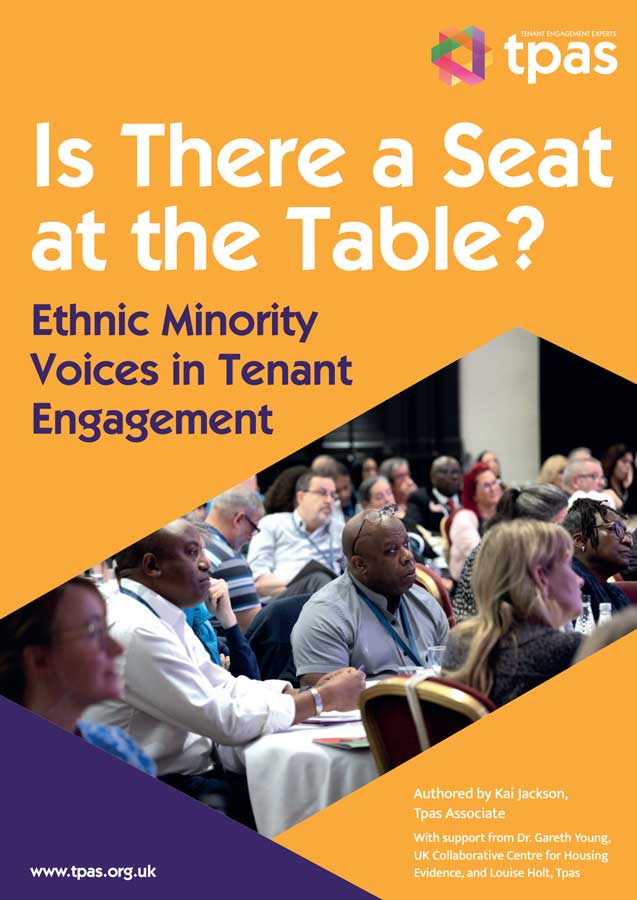
My recent report, Is There a Seat at the Table? Ethnic Minority Voices in Tenant Engagement, shows how these inequalities persist in residents’ everyday experiences. Based on surveys of 178 tenants and 175 staff across 25 housing providers, the report found that 94% of respondents believe their organisation could do more to bring tenants from ethnic minority backgrounds into decision-making roles. Nearly every tenant agreed that engagement structures still fail to reflect the diversity of the communities they serve.
“Inclusion is not a box-ticking exercise, but a condition for trust.”
Question of democracy
This isn’t just a diversity issue – it’s a question of democracy. Who gets to shape housing policy? Who gets heard when decisions are made about safety, regeneration, or community investment? When tenants from ethnic minority backgrounds are excluded from those spaces, the system loses insight, accountability and fairness.
Yet despite the long shadow of inequality, there is cause for optimism. Across the housing sector, a quiet transformation is taking place. This is led by residents, staff and leaders who understand that inclusion is not a box-ticking exercise, but a condition for trust.
Tenant-led scrutiny panels are holding boards to account. Housing associations are embedding cultural competence into training and governance. Regulators are making tenant voice, safety and respect central to the implementation of the Social Housing Regulation Act 2023. These changes are reshaping what good housing governance looks like in England.
Consultation to co-creation
Crucially, many organisations are beginning to move beyond consultation to co-creation – working with tenants as partners, not participants. They’re building engagement structures that feel personal, rooted in community and reflective of the people they serve. The best are celebrating the cultural richness that tenants bring, rather than treating diversity as a challenge to manage.
Still, progress is uneven. In too many cases, residents’ voices – particularly from ethnic minority communities – are heard only after a crisis. If social housing is to live up to its purpose, it must go beyond building homes to rebuilding trust.
That means recognising cultural competence as a core skill for all housing staff, designing homes suitable for larger families, ensuring allocation systems are transparent and equitable, and embedding anti-racism into housing practice.
Because without intentional change, the inequalities visible in the 1960s don’t just remain – they evolve. The signs may be gone, but the barriers persist.
The next chapter
The next chapter for social housing can be one where race equality is not a reactive issue but a shared value – woven into leadership, service design and community life. Every inclusive meeting, every resident who feels heard, every staff member who learns to listen differently contributes to a wider shift towards justice.
This is an opportunity to lead with hope. If the sector continues to learn, to listen and to act with courage, then social housing can finally become what it was always meant to be: a foundation for fairness, dignity and belonging for all.
So, I'm calling for the housing sector to commit to mandating cultural competency training, more robust demographic data collection and a focus on building community cohesion.
Because a fair housing system isn’t just about bricks and mortar – it’s about belonging.
“Every inclusive meeting, every resident who feels heard, every staff member who learns to listen differently contributes to a wider shift towards justice.”