Image: Istock
Reframing feminine power in housing and beyond
Women are underrepresented in leadership roles – correcting this imbalance starts with changing how we listen to women
PEOPLE & CULTURE

Tracey McEachran
Senior Associate, Campbell Tickell, and Chair of Women in Social Housing (WISH)
Tracey McEachran
Senior Associate, Campbell Tickell, and Chair of Women in Social Housing (WISH)
Issue 81 | December 2025
We have been raised in the house of men. As Meryl Streep so acutely observed, women have not only learned the language of men, but they also dream in it. We have become fluent in the cadence of logic, certainty, and structure. And in doing so, we have often muted our native tongue – one of possibility, intuition, vulnerability, and connection.
Over the years, this tension has lived quietly beneath the surface of my work as a coach, an artist, a leader, and a woman. Recently, however, a series of experiences converged that brought it crashing to the fore. An email from the Institute of Directors revealed that more than 70% of its Director Award nominees were men. A Facebook post celebrating top coaches listed mostly men. A widely praised male coach shared two examples of his high-performing clients, both men. Each moment was small, explainable, but together they formed a pattern. A quiet, persistent erasure.
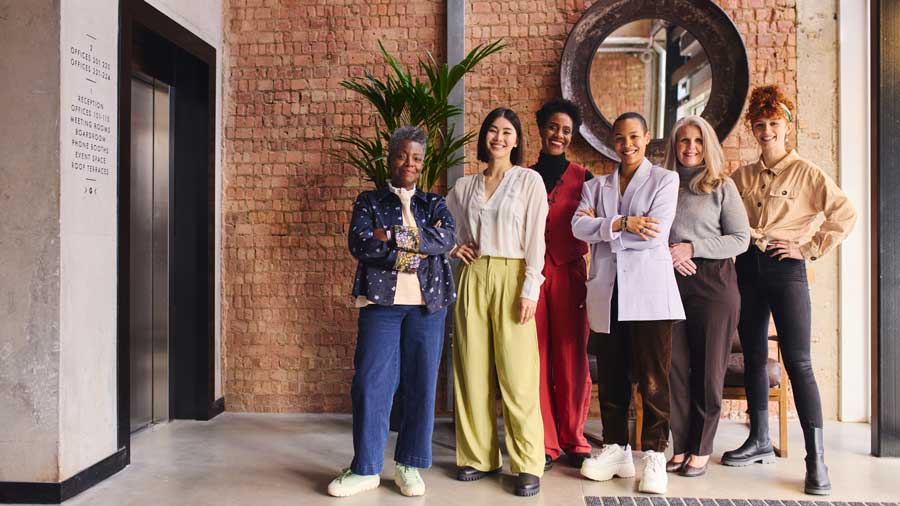
Even in our social housing sector where more than half the workforce and residents are women, leadership remains notably masculinised. Among the G15, London’s 15 largest housing associations, just three of the CEOs are women. Across the wider sector, women make up 54% of the workforce, yet occupy just 39% of executive team roles, 36% of board roles, and only 34% of CEO positions. The disconnection between representation at workforce level and leadership level reflects a pattern of underrepresented feminine leadership across both high-profile and smaller organisations.
of executive roles in the social housing sector are occupied by women, despite women making up 54% of the workforce
of board roles in the social housing sector are occupied by women
of CEO positions in the social housing sector are occupied by women
The ‘animus’ and the ‘anima’
Yet this isn’t simply about representation. It’s about tone and how we listen. I attended a conference where Linda Pransky, deeply respected as a psychologist and coach in her field, spoke of wishing she could find the right words to help people understand their innate wellbeing. Her humility, her not-knowing, was palpable and deeply powerful. But would it have been received as authoritative had it come from a man? Probably not. And would a man have said it in the first place?
We live in a world that is overdeveloped in its masculine energy: what Carl Jung would call the animus. The animus speaks in structure, in strategy, in knowing. It builds, defines, and directs. Its counterpart, the anima, is the domain of feeling, of intuition, of emergence. It does not demand answers but invites presence. Both are necessary. Both are sacred. Both exist in all of us. But our culture has lost sight of the anima’s value.
I began researching the most popular inspirational internet TED Talks of all time. Of the top 50, women account for just 25-30%. More telling than numbers alone, however, is the tone. The men present bold frameworks and assertive truths: the ‘why’ behind leadership (Simon Sinek), the failure of schools to nurture creativity (Ken Robinson), the global data that refutes our biases (Hans Rosling). These talks lead with certainty, with a confident, rational voice that maps clearly to the animus.
“Women internalise this imbalance. They speak their truth with caveats. They apologise for their insight. They doubt their intuition even when it’s proven right.”
A different voice
The women speak differently. Brené Brown leads with vulnerability. Amy Cuddy explores the relationship between posture and confidence with gentle curiosity. Chimamanda Ngozi Adichie tells stories that unfold into insight. Their talks are often softer in tone, but not in impact. Yet culturally, we still associate impact with certainty. With authority. With the animus.
Mindvalley, another successful and inspirational platform for personal development, shows a similar pattern. Women lead programmes on intuition, relationships, healing. Men dominate in frameworks, productivity, and high-performance. Even when both are present, the animus is the loudest in the room and that will be driven by audience numbers.
What this reveals is a deep cultural coding: that the voice of certainty is more trustworthy than the voice of emergence. That knowledge trumps wisdom. That structure is more valuable than intuition.
This isn’t a call to devalue masculine energy. On the contrary, we need the animus. But not alone. When the animus is overdeveloped and the anima undernourished, we create a society that is out of balance.
As a coach and artist, I see how many women internalise this imbalance. They speak their truth with caveats. They apologise for their insight. They doubt their intuition even when it’s proven right. And I see how many men hunger for permission to feel, to not know, to soften.
AI and the future
There is a further, urgent dimension to this. As artificial intelligence continues to develop at an exponential rate, drawing on the data and systems that already exist, we must confront the likelihood that AI will not challenge this imbalance but accelerate it. If AI is trained on a world shaped predominantly by animus energy – certainty, logic, structure – it will replicate and amplify those patterns. It will reinforce the systems we have, not the systems we need.
Unless we are intentional, the intuitive, relational, and feeling-based ways of knowing, the voice of the anima, will become even more marginalised in the digital age. This is not just a cultural concern; it is a design challenge and a moral imperative. If we want AI to reflect humanity’s wholeness, we must teach it to listen differently too.
This imbalance has real-world consequences, especially in sectors now embracing new technologies. The social housing sector, like many others, is increasingly looking to AI to streamline services, personalise customer interactions, and improve efficiency. But if its design and deployment are not intentionally inclusive, we risk importing and scaling the very biases we are trying to dismantle. If the animus-coded voice of certainty dominates our digital tools, we may create solutions that are efficient but not empathetic, structured but not soulful. In a sector that serves diverse, often vulnerable communities, this matters.
“Unless we are intentional, the intuitive, relational, and feeling-based ways of knowing, the voice of the anima, will become even more marginalised in the digital age.”
Time for rebalance
The time has surely now come to restore and celebrate the anima. Not to reverse the power structure, but to rebalance it. To create space for a new kind of voice – one that does not declare but invites. One that leads from centre, not the edge. One that honours emergence, complexity, and heart.
We are all responsible. And we are all capable. The question is not whether the feminine voice has value. It’s whether we are ready to listen.